SMBmarket: Marketplace
500+ users, 85,000+ listings- yet people left before seeing a single deal. SMBmarket saw a first-time-buyer problem; I saw a three-sided one. Our redesign drove a 166% increase in subscribers.
Role
Product Designer
Collaboration
4 UX Designers, 3 UX Engineers
Tools
Figma, Google Workspace

Was helping first-time buyers the whole story?
The client's request sounded straightforward: help first-time buyers with onboarding and retention. They came with a wishlist, too: a deal calculator with compatibility scores.
But "help first-time buyers" was vague. With only three months, my team and I couldn't chase everything, so I walked into that first meeting wanting three things:


Needs vs. wants
No, it wasn't the whole story.
I kept coming back to one thing: the problem was framed around a single user- the buyer. But a marketplace has three sides, and they were tangled together:
Buyers couldn't navigate. First-timers lean on visuals, and the site was a wall of text.
Sellers couldn't stand out in 85,000 listings; many had no professional photo.
SMBmarket didn't have images at all

One problem, three faces. You can't fix the buyer's experience without fixing the seller's and the platform's, too, and that reframe became the foundation of everything I did.
There was just one catch: my team wasn't there yet.
"What is the actual problem we're solving?"
Getting the team back to the problem
What it's like to be a buyer
I didn't know the first thing about buying a business. My team and I ran a competitive analysis, but I wanted more. We were studying what competitors looked like, not how a beginner actually moves through the confusion.

So I went where first-time buyers actually talk: forums where they vent their frustrations.
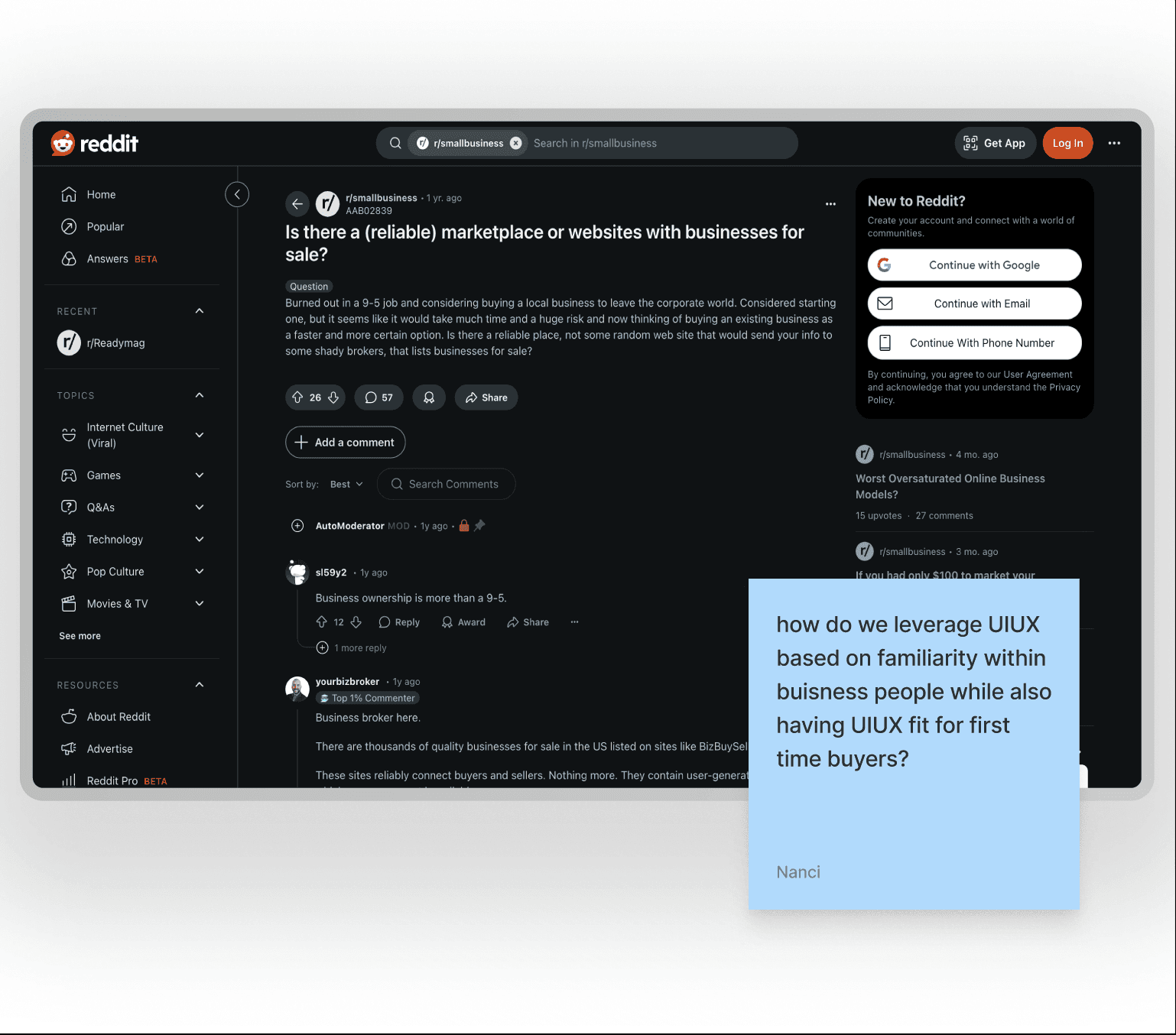

What the forums taught me
I chose the unflashy route
I chose to lead the Marketplace ("All Listings") page over flashier options like the landing page, even knowing it sits behind a paywall, where recruiters might never see it. The most visible page isn't always the most important one.
The card is the core of the experience, so it's where I spent the most time. Every decision traced back to one principle: recognition over recall.
Cards over a blank search. A blank bar forces users to recall what to type; visible cards and filters let them recognize options- less cognitive load.

Shorter filter words. I cut long phrases to single-word anchors: "Select Target Industries" became "Industries." Shorter words read faster.

A clear metric hierarchy. I surfaced the Top 3: Industry, Location, Cash Flow, up front, so buyers can compare at a glance instead of reading a wall of text.
The anatomy of a card (and the "peeking" label)
A small AI move for all three sides
The three-sided lens pointed at one fix I designed: AI-generated listing images. Feed the seller's description to an AI, and it generates a clean, representative image- a cafe or a donut shop that captures the business at a glance.

It served all three sides at once. The buyer gets the visual cue they navigate by, the seller gets a professional listing without hiring a photographer, and SMBmarket fills the image gap it couldn't fill before.
It was small, and it didn't make the final cut as a headline feature, but it's the clearest example of what three-sided thinking produces: one change that serves everyone, not just the user you were told to design for.
166% increase in subscribers- 1,000+ new users
After launch, the client told us in their words: "Users love the site and the ease of use." Because the client didn't use Figma, we cleaned up our files and built an annotation page so they could maintain the work after we left.