Salesforce: Loyalty Program
How can we trust AI in loyalty offer management? Through human agency. AI streamlines the process, and marketing managers have the final say. Through mixed methods research, we gave Salesforce 4 recommendations.
Role
UX Researcher
Collaboration
C360 Applications & Industries team
Tools
Mixed Methods
What I can't show you
Our findings shaped four recommendations for the C360 team, spanning transparency, user control, smarter configuration, and guardrails for AI-driven offers. Per our agreement with Salesforce, the specific insights stay with them. The thinking behind them is what this case study explores.
The brief
Salesforce wanted to improve its loyalty system.
Marketers were spending hours doing by hand what should've taken minutes: pulling customer lists, building rules, checking for conflicts, launching offers one by one. And after all that work, customers still got promotions that felt like they were meant for someone else.
The problem wasn't a lack of data or technology. It was that nothing connected. Salesforce called it "orchestrating relevance at scale"- getting the right offer to the right person at the right moment, automatically, without anyone losing trust in how it happened.


Four things were an issue:
Offer creation was too manual to scale.
Personalization broke down past basic segmentation.
Marketers couldn't explain why a specific offer was chosen for a specific customer.
Customers received offers that felt disconnected from their real lives.
Salesforce wanted to know if AI could fix that, without becoming the very black box that made marketers distrust the system in the first place.
The wall
My team and I hit a wall. We were undergrads. No marketing connections, no budget for incentives, and a target list of mid-career CRM managers who have absolutely no reason to answer our cold LinkedIn message.
I began outreach, but I had no LinkedIn Premium, so my reach was capped from day one. Weeks of messages. Almost nothing back. The one interview I landed became one of the richest in the project, and it came from a relationship, not a cold message.

What actually worked
Our team also made the honest call to bring in proxy users and end users alongside the marketers we could reach, instead of pretending we'd talked to more "real" ones than we had.
This came from a conversation we had with our professor and he said something that I will never forget:
"Can't have qualitative analysis without qualia."

Asking the client the harder question
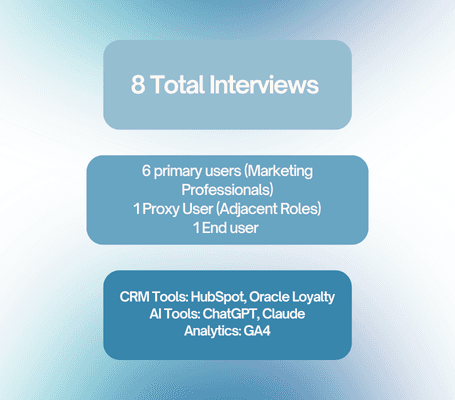
By the end, my team had conducted 8 interviews- 6 marketing professionals, 1 proxy, 1 end user- plus a broader survey and a teardown of Oracle, SAP Emarsys, SessionM, and Epsilon. My contribution on the interview side was the connection I sourced: a marketing professional I reached through my club advisor, whose firsthand experience with loyalty tools became one of our sharpest data points.
Questions that actually opened people up
Two sides, one trust problem
Marketers didn't trust the black box. AI was welcome for efficiency- drafting, summarizing- but not for deciding. Even Epsilon, the most powerful platform we studied, couldn't tell a marketer why it picked an offer. The smarter the AI got, the less anyone could vouch for it.
End-users didn't trust the repetition. Over half of our survey respondents said offers were often irrelevant or badly timed. They unsubscribed, muted, and deleted. Real-time offers split people almost exactly in half: magical to some, creepy to others, depending on nothing but whether they felt in control.

Same answer, both sides: trust isn't about how smart the system is. It's about who stays in control.
Outcomes & reflection
If I ran this again, I'd build the relationship-based recruiting from week one.
This project taught me that the research method is the design problem. When you can't reach the user you wanted, the honest move isn't to fake the data. It's to be upfront about who you actually talked to, and let that shape how loudly you state your conclusions.
What this project taught me
Relationships beat tools. One warm intro outworked weeks of cold LinkedIn messages.
Constraints are part of the method, not an excuse for skipping it. The proxy-user pivot wasn't a shortcut; it was an honest adaptation we could defend out loud.
Push the SME, don't just survey them. The sharpest research questions came from pressing our mentors, not from the brief alone.
Trust is structural. For marketers and customers both, it came down to the same thing: control.


